
 Written By
  Reviewed By Aylani Brian
Introduction
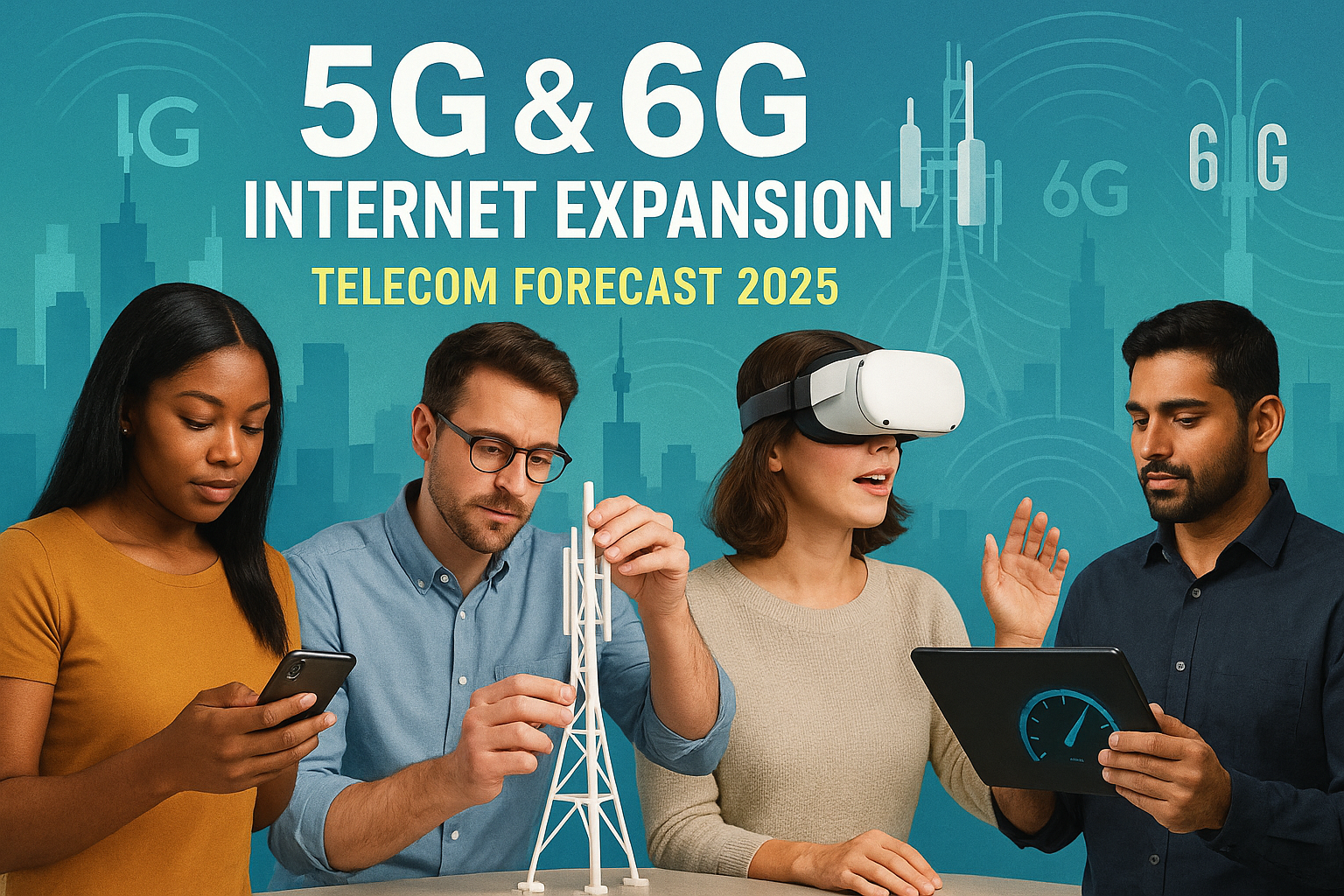
Mobile internet is about to change again. In 2025, telecom providers will push out 5G to more areas. At the same time, research on 6G will speed up. These shifts matter for all of us. Faster downloads, lag-free calls, and smart city services will become common. In this article, we explore the 5G expansion and the long term 6G forecast for 2025. We break down key data, explain why network resources are growing, and share tips to get ready. Let’s dive into the world of wide range telecom trends 2025.
What Is 5G and 6G?
5G stands for fifth generation. It began rolling out in 2019. It offers much higher speeds than 4G. You can stream high-definition video on a phone. You can connect more devices without slowing down.
6G is still in the lab. It will follow 5G around 2030. Early tests aim for speeds ten times faster than 5G. Experts expect ultra-low latency under one millisecond. That will unlock new uses like holographic calls and remote locations surgery.
Both networks use radio waves. They rely on new antennas and towers. 5G uses millimeter waves and mid-band spectrum. 6G may tap terahertz bands. These changes let carriers carry more data at once.
Why Are Networks Expanding in 2025?

Demand for data keeps growing. Video streaming, online gaming, and virtual events require fast links. Smart homes and Internet of Things (iot sensors) devices also need robust connections.
Governments support network growth with funding and spectrum auctions. They want to boost digital economies. Rural areas will get more 5G coverage in 2025. This closes the digital divide.
Carriers compete for customers. They offer new plans and mobile devices that work on 5G technology. They invest in upgrades to stay ahead. This drive speeds up the mobile network growth.
Key Benefits of 5G and 6G

Faster speeds are the headline benefit: downloads that once took minutes now finish in seconds. Lower delay, or latency, means voice calls, video chats, and online games feel instant and clear. More devices can connect at once without slowing the network, letting homes pack in smart lights, appliances, and security controls cams. Industries like healthcare and manufacturing gain from remote surgery tools and automated factories that need split-second data. As 6G comes nearer, we’ll see breakthroughs like holographic calls and virtual worlds that feel more real than ever.
- Higher Speeds: 5G can reach 1–3 Gbps in real-world tests. 6G trials aim for 10–20 Gbps.
- Low Latency: 5G latency can drop under 10 ms. 6G hopes to hit 1 ms or less. This matters for real-time apps.
- Massive Network Connectivity: 5G supports up to 1 million devices per square kilometer. 6G may double that.
- Energy Efficiency: New network designs use less power per bit of iot data. This reduces operating costs.
- New Services: Enhanced mobile broadband, fixed wireless network access, network slicing for tailored services, and advanced IoT.
These advances set the stage for smart factories, remote health care, and self-driving cars. The future wireless connectivity tech will reshape many industries.
What Technologies Underpin 5G Networks?

1. Millimeter-Wave Spectrum
High-band 5G (mmWave) offers multi-gigabit speeds. Short range—200–500 meters—requires many small cells in dense areas.
2. Sub-6 GHz Spectrum
Mid-band balances coverage and capacity. Operators globally refarm 3.5 GHz or 4.9 GHz bands for broad 5G reach.
3. Massive MIMO Antennas
Massive multiple-input multiple-output (MIMO) uses dozens of antenna elements. Beamforming directs signals to devices, boosting throughput and efficiency.
4. Fiber Backhaul
High-capacity fiber links cell sites to core network segmentation. Fiber provides low-latency, high-bandwidth backhaul essential for 5G performance.
5. Edge Computing
Multi-access controls edge computing (MEC) places personal data centers near cell sites. This reduces latency for critical applications like AR and autonomous driving.
Why 6G Matters for Consumers and Industries

6G’s ultra-high speeds, low latency, and sensing capabilities unlock new applications:
- Holographic Communication: 3D telepresence in real time.
- Autonomous Vehicles: Cooperative driving with millisecond coordination.
- Remote Medicine: Haptic feedback surgery across continents.
- Smart Factories 2.0: Autonomous robots with near-zero delays.
- Metaverse Access: 16K VR customer experiences streamed directly to lightweight headsets.
These advances rely on 6G’s performance leaps over 5G, enabling seamless virtual and physical integration.
How Carriers Plan Coverage in 2025

Telecom operators follow a phased plan:
- Phase 1 Urban Core: Major cities get dense coverage first.
- Phase 2 Suburbs: Next, networks expand to suburbs and towns.
- Phase 3 Rural Reach: Finally, operators fill gaps in countryside regions.
New micro-cells and small cells boost indoor signals. Carriers partner with landlords to install equipment. Spectrum sharing deals also help fill coverage holes.
Tips to Prepare for High-Speed Mobile Internet
Get ready for internet speed evolution with these simple tips:
- Check Your Device: Make sure your phone or tablet supports the latest 5G bands.
- Plan Your Data: Unlimited plans can avoid surprise bills when speeds increase.
- Secure Your Network: Use strong passwords on home routers and enable two-factor authentication.
- Update Software: Keep your device firmware and apps up to date for best performance.
- Test Coverage: Use apps to map 5G signal strength in your area. Switch carriers if service is weak.
These steps help you enjoy the full power of future wireless tech as it arrives.
Emerging Use Cases in 2025
New mobile services will appear as computer networks improve:
- Industry 4.0: Factories use real-time data to automate lines and prevent defects.
- Smart Cities: Network traffic lights, waste management, and energy grids link via 5G for efficiency.
- Healthcare: Remote diagnostics and robotic surgery become more reliable connectivity with low latency.
- Education: Virtual classrooms and AR field trips offer immersive learning experiences.
- Entertainment: Cloud gaming streams high-end games to any device without local hardware.
As 6G research grows, we may see holographic calls, instant translation tools, and sensory-rich virtual worlds.
Challenges Lie Ahead
Rolling out 5G and preparing for 6G is not easy:
- Cost of Network Infrastructure: Building towers and fiber backhaul is expensive.
- Spectrum Allocation: Regulators must assign new bands. Auctions can be slow.
- Device Upgrades: Users need 5G-capable phones and routers.
- Power and Heat: High-frequency radios can overheat and use more power.
- Security Risks: More connected devices open new attack paths. Carriers must invest in strong network security systems.
Despite these hurdles, the benefits outweigh the challenges. Carriers and policymakers work together to keep progress on track.
Future of 5G & 6G Internet Expansion

Looking ahead, 6G trials will ramp up around 2025, with pilot projects showing speeds 10 times faster than 5G. Networks will merge ground, air, and space links—drones, high-altitude platforms, and satellites will work together. AI and machine learning will run network adjustments automatically, keeping connections smooth even at peak times. Businesses will use these advances for fully remote surgeries, self-driving fleets, and ultra-high-definition broadcasts. By the end of the decade, our digital world will feel more immersive and instant, thanks to the leap from 5G to 6G.
Comparison Table: 5G and 6G in 2025
| Feature | 5G (2025 Coverage) | 6G (2025 Status) |
|---|---|---|
| Peak Speed | Up to 3 Gbps | Lab tests up to 20 Gbps |
| Latency | 5–10 milliseconds | Target under 1 millisecond |
| Spectrum Bands | Sub-6 GHz, mmWave (24–52 GHz) | Early research on terahertz |
| Device Density | 1 million devices/km² | Expected 2 million devices/km² |
| Use Cases | HD streaming, AR/VR, IoT | Holograms, tactile internet |
| Deployment Stage | Wide rollout in urban areas | Pre-commercial trials |
Conclusion
The 5G expansion of 2025 will bring faster speeds, lower delays, and wider coverage. At the same time, the 6G forecast supply chains shows promise for even more dramatic improvements. Businesses, governments, and consumers stand to gain from these advances. Carriers face costs and technical hurdles, but they have clear plans to overcome them. By checking your device, securing your network, and choosing the right plan, you can tap into telecom trends 2025 with ease. The evolution in mobile internet will drive new internet services, boost productivity, business operations, security solutions, and enrich our daily lives.
Call to Action
Ready to harness 5G speeds and prepare for 6G? Visit our site to compare 5G plans, check social media device compatibility, and join our webinar on next-gen networks. Stay ahead in the world of mobile internet!


