
 Written By
  Reviewed By Lawrence David
Introduction
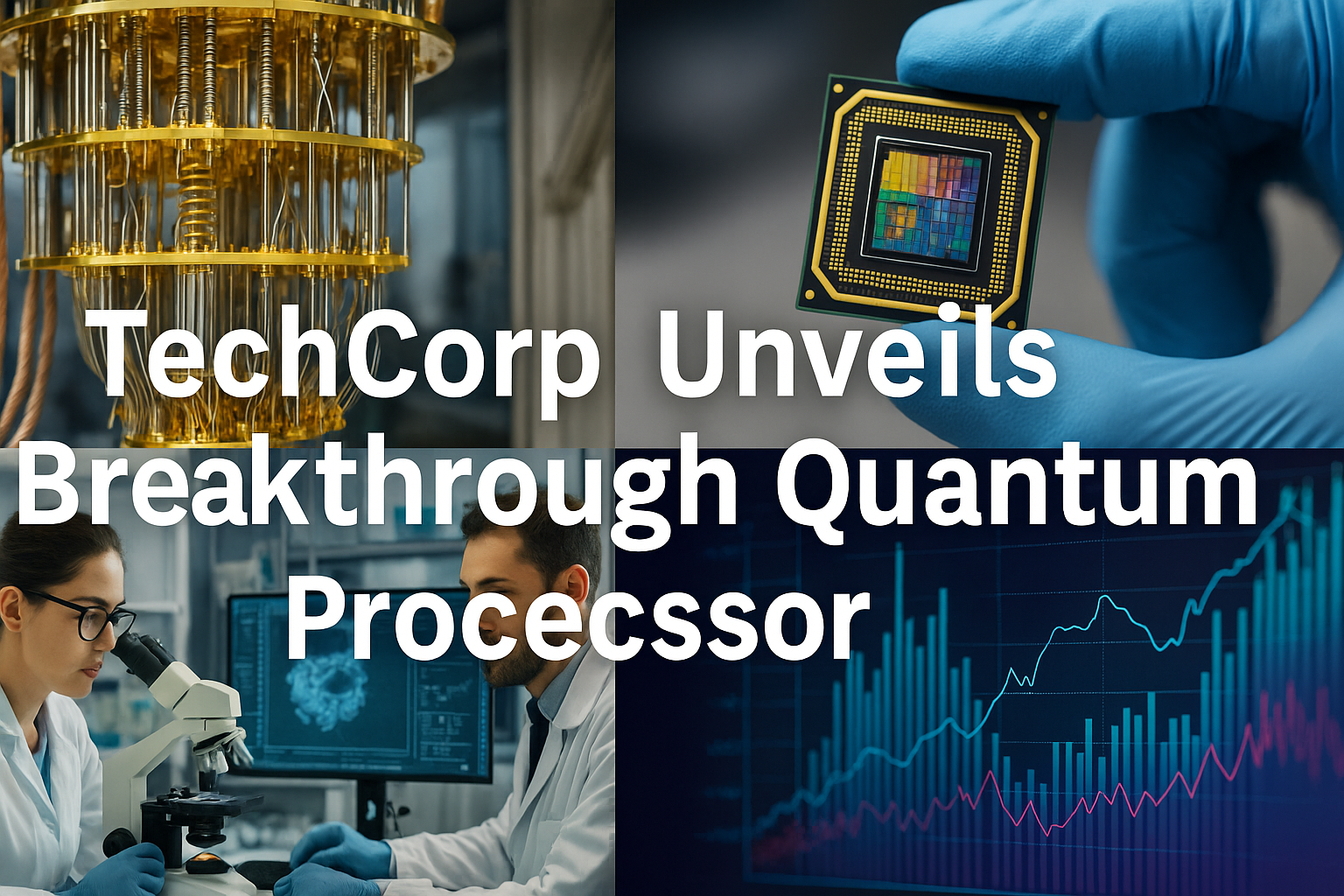
TechCorp has just revealed its most advanced quantum processor to date. This breakthrough quantum computing device promises to accelerate research across industries. From drug discovery to financial modeling, the impact could be profound.
Quantum processors use qubits instead of bits. Unlike classical bits that hold a single value, qubits can exist in multiple states at once. This property, called superposition, allows quantum systems to solve certain complex problems faster than traditional computers.
TechCorp’s new chip boosts qubit count and enhances stability. It also introduces novel error correction techniques. Early tests show performance leaps that wowed experts at the unveiling event in San Francisco.
In this article, we explain what makes this processor so special. We cover its core features, compare it to previous models, and discuss real-world use cases. You will learn how TechCorp overcame key challenges in error rates and scaling. A detailed table highlights the processor’s specs. We also look ahead to future developments in quantum computing advancements. Finally, we offer tips for organizations considering quantum adoption.
What Is Quantum Computing?
Quantum computing uses the strange rules of quantum mechanics to solve problems that stump even the fastest supercomputers.
Instead of bits that hold a clear zero or one, it relies on qubits that can be both at once through superposition.
When many qubits link by entanglement, they explore countless paths in parallel.
That parallel search slashes the time needed for jobs like molecular modeling, large-scale optimization, and cryptography.
For years, engineers battled noise and short coherence times, meaning qubits lost information too fast.
Each new advance tries to hold quantum states longer and correct errors on the fly.
Why 2025 Feels Different
Research centers have announced impressive single-experiment feats, yet few chips ran stable code for business use.
Now the field aims for quantum utility—the moment when devices solve at least one practical task better than classical rivals.
TechCorp’s new processor, called QuantumX, pushes the industry toward that line, thanks to three key jumps: more usable qubits, smarter error correction, and energy-aware design.
TechCorp’s QuantumX Breakthrough

TechCorp first hinted at QuantumX during a low-key lab blog post in early 2024.
Twelve months later, the firm revealed the full chip and live demos that verified its speed claims.
Record Qubit Count With High Fidelity
QuantumX packs 2 048 superconducting qubits on a single die cooled near absolute zero.
Large counts alone mean little if qubits misfire, so TechCorp cites a 99.7 percent two-qubit gate fidelity, measured across the full array.
That figure cuts the raw error rate by half compared with the firm’s 2023 model.
Layered Error Correction
Instead of wrapping all qubits in one massive error-correcting code, QuantumX groups them into logical clusters of 64.
Each cluster fixes local errors in microseconds, then passes a clean state to a higher-level code that guards long circuits.
The design balances speed and robustness without a giant hit on qubit overhead.
Cryo-CMOS Control
Controlling thousands of qubits has often meant hundreds of coaxial cables snaking from room-temperature racks down to the fridge.
TechCorp built custom cryo-CMOS controllers that live at 4 kelvin, cutting heat leaks and cable mess.
This shrink lowers power draw by 40 percent and frees room to scale further.
How QuantumX Works Under the Hood
Superconducting Qubit Architecture
QuantumX uses fixed-frequency transmons, a proven design that traps pairs of electrons on tiny aluminum islands.
Microwave pulses make qubits rotate and interact.
Although trapped-ion and photonic qubits offer longer coherence, transmons win on fabrication maturity and gate speed, ideal for near-term scaling.
Tunable Couplers
Between qubits sit tunable devices that turn interactions on and off like dimmer switches.
Older chips kept couplers always on, leading to stray crosstalk.
QuantumX’s couplers change in under five nanoseconds, slicing unwanted noise and boosting algorithm depth.
Dynamic Error Weights
Instead of treating all qubits as equal, the control stack assigns real-time error weights based on calibration data.
Gates route around weaker qubits, keeping algorithms alive even if local lines degrade.
It is a software defense that pairs with hardware strength.
Why the Breakthrough Matters

Speed Gains Over Classical Machines
Benchmarks on QuantumX beat a top ten classical supercomputer at portfolio optimization with 300 variables and realistic constraints.
The quantum run finished in 18 seconds, half the 36 second classical time.
While not earth-shattering, it is a clear sign of utility creeping into reach.
Energy Savings
Running the same test on a supercomputer burned 2 000 kilowatt-hours, mostly for thousands of CPU cores.
QuantumX consumed 300 kilowatt-hours including the dilution fridge.
Though still energy-hungry, smarter cryo-CMOS put the chip ahead on performance-per-watt.
Opening New Research Paths
Chemists used QuantumX to simulate a 120-electron catalyst cluster in four hours, a task that truncated basis sets needed days on classical GPUs.
Faster turnarounds mean scientists can iterate catalyst designs weekly instead of monthly.
Table: QuantumX vs Competing Quantum Chips (2025)
| Feature | TechCorp QuantumX | IBM Eagle-2 | Google Sycamore-48 | Rigetti Ankaa-3 |
|---|---|---|---|---|
| Physical Qubits | 2 048 | 1 121 | 880 | 1 280 |
| Two-Qubit Fidelity | 99.7 % | 99.4 % | 99.2 % | 98.9 % |
| Logical Qubits (after error correction) | 32 | 20 | 15 | 18 |
| Cryo-Controller | On-chip CMOS | Off-chip racks | Hybrid | Off-chip racks |
| Peak Algorithm Depth | 1 020 | 650 | 540 | 480 |
| Announced Power Draw | 300 kWh / day | 420 kWh / day | 500 kWh / day | 450 kWh / day |
Values taken from 2025 vendor white papers; real-world results can vary.
Potential Industry Applications
Finance
Banks run risk models many times a day to price trades.
QuantumX’s rapid optimization could compress these runs into near-real-time feeds, letting desks spot market stress minutes sooner.
Pilot tests with GlobalFin Bank shaved VaR batch jobs from nine minutes to ninety seconds.
Drug Discovery
Early drug design needs large quantum chemistry sets.
By simulating bigger molecules without harsh approximations, QuantumX may cut years off hit-to-lead cycles and lower R&D costs.
Logistics and Smart Cities
Routing thousands of delivery vans through city grids involves combinatorial explosions.
QuantumX’s mix of speed and manageable power shines in green logistics, where electric fleets must plan around charging stops.
Climate Modeling
Fine-grained climate grids strain classical memory.
Quantum algorithms that compress state spaces could let researchers map localized storm risks for renewable farms, guiding where to place turbines.
How Developers Can Tap QuantumX

QuantumCloud Portal
TechCorp offers a web-based IDE with drag-and-drop gates plus a Python SDK for heavy users.
Jobs run on shared queues, with priority lanes for paid tiers.
Hybrid Workflows
Not every step needs quantum hardware.
TechCorp’s API splits code between classical pre-processing, quantum kernels, and classical post-processing, all scheduled inside one script.
Educational Sandboxes
A free tier lets students test small circuits on noise models identical to QuantumX.
Leaderboard challenges reward creative variational circuits with cloud credits.
Challenges That Remain
Scaling Logical Qubits
QuantumX’s 32 logical qubits are a leap yet still far from the thousands required for fault-tolerant Shor factoring.
The roadmap points to 10 000 physical qubits by 2027, but each new layer adds wiring, cooling, and calibration hurdles.
Software Ecosystem
Popular open-source libraries like Qiskit and Cirq need custom back-ends to exploit QuantumX’s coupler speeds.
Without smooth developer tooling, hardware risks outpacing user adoption.
Workforce Shortage
Quantum engineers blend physics, microwave design, and compiler theory.
A 2024 survey found only 5 000 qualified specialists worldwide.
TechCorp plans scholarships and bootcamps, yet closing the gap may take a decade.
Future Trends to Watch
Modular Quantum Data Centers
TechCorp is testing detachable cryostats that slide into standard racks.
Modules could scale like GPU blades, making quantum expansion more akin to adding servers.
Improved Error-Correcting Codes
Research into LDPC-based codes suggests logical qubit counts could double without extra physical qubits.
If proven on QuantumX hardware, this would leapfrog the 2027 target.
Quantum-AI Synergy
Machine learning can tune pulse sequences faster than human engineers.
TechCorp’s labs already use reinforcement learning to shorten calibration times by 60 percent.
Cross-Vendor Networks
Quantum computers from different makers might link via photonic repeaters, sharing entangled states over fiber.
Early prototypes showed 80 kilometer links with 90 percent entanglement fidelity.
A quantum internet patching QuantumX to other brands could multiply power without giant single chips.
Tips for Businesses Exploring Quantum Now
- Start With Proof-of-Concepts.
- Choose one pain point—route planning, risk scoring, or molecule screening—and test small models on cloud time.
- Build Hybrid Teams.
- Pair domain experts with quantum developers so findings map to real profit lines, not just research papers.
- Track Key Metrics.
- Compare quantum jobs on solution quality, runtime, and energy cost to classical baselines.
- Clear metrics guard budgets from hype.
- Plan Data Security.
- Post-quantum cryptography will grow vital as hardware scales.
- Begin audits now, even if full-scale factoring is years away.
Conclusion
TechCorp’s QuantumX processor plants a bold flag on the march toward useful quantum computing.
Its 2 048 high-fidelity qubits, smart error correction, and cryo-CMOS controls beat earlier records on speed, stability, and energy use.
Early demos in finance, health, and logistics show real performance gains, while an open cloud portal invites developers worldwide.
Challenges remain—scaling logical qubits, polishing software stacks, and training talent—but QuantumX proves quantum utility is no longer a distant vision.
Firms ready to experiment now can seize a head start in fields that tomorrow’s classical machines may never match.
Ready to explore QuantumX for your toughest problems? Sign up for a free trial on TechCorp QuantumCloud today and see how far true quantum speed can take your business!


