 Written By
  Reviewed By Benson Scott
Introduction
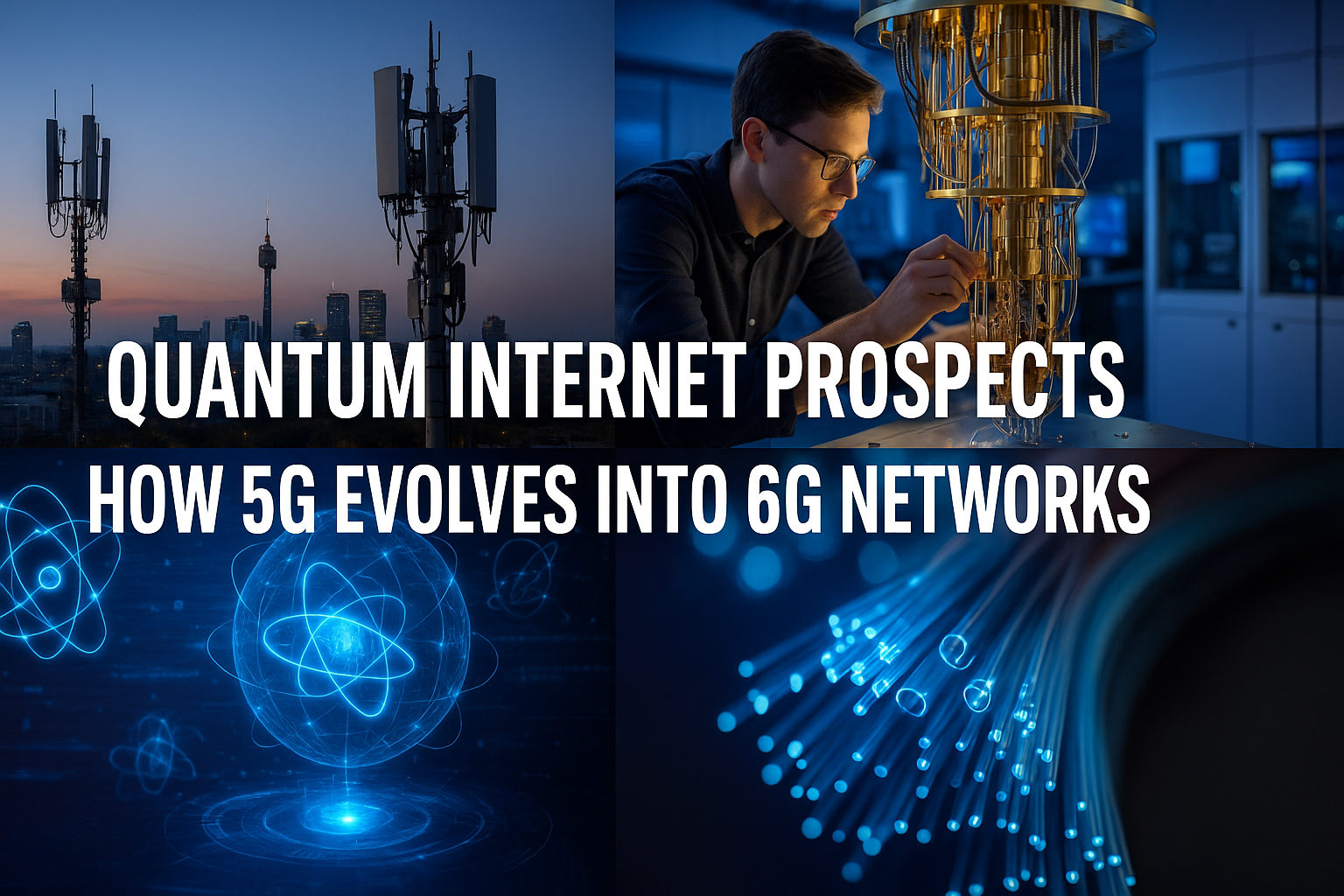
Mobile networks have grown by leaps and bounds. We went from 3G to 4G, and today we use 5G. Now experts are working on 6G. This next step will bring even faster speeds and smarter connections. A new idea called the quantum internet could play a key role. It uses quantum physics for ultra-secure links and near zero latency. In this article, we explore what the quantum internet is and how 5G will evolve into 6G. You will learn about new technologies, possible uses, and what stands in the way. By the end, you will see how our world of devices and data will change.
What is the Quantum Internet?
The quantum internet is a network that uses the principles of quantum mechanics. Instead of sending bits that are either 0 or 1, it sends quantum bits or qubits. Qubits can be both 0 and 1 at the same time. This odd feature is called superposition. Another feature is entanglement. When two qubits become entangled, they stay linked. A change in one qubit affects the other instantly, even if they are far apart.
Quantum networks promise near unbreakable security. Any attempt to spy on qubits breaks their state. This makes hacks easy to spot. Quantum links also offer near instant communication once entangled. Current research labs have shown small quantum networks over a few kilometers. The goal is to connect cities and nations with quantum repeaters and satellites.
How 5G Works Today
5G is the fifth generation of mobile networks. It brought big improvements over 4G. Peak speeds can reach 20 gigabits per second under ideal conditions. Average speeds are closer to one or two gigabits. 5G also cuts latency to just a few milliseconds. This means less lag for gaming, virtual reality, and real-time apps.
To achieve this, 5G uses a mix of low, mid, and high frequency bands. Low bands cover wide areas but offer lower speeds. Mid bands strike a balance. High bands—known as millimeter waves—deliver top speeds but cover shorter distances. Carriers use new antennas, called massive MIMO, to beam signals to many devices at once. They also implement network slicing to dedicate bandwidth to critical services like emergency calls or factory robots.
While 5G is impressive, it still has limits. Millimeter waves struggle to travel far and are blocked by walls and rain. Dense urban areas need many small cells to fill gaps. Moreover, security relies on encrypting classical data, which may be vulnerable in the future to quantum attacks.
Limitations of 5G Driving 6G Development
As 5G rolls out worldwide, researchers already plan 6G. They seek to overcome 5G’s limits and add new features. For example, 5G’s top speeds peak under ideal tests. In real life, network congestion brings them down. Many cities face slow spots where users share bandwidth.
Latencies under five milliseconds are great, but some applications need even faster links. Autonomous vehicles, remote surgery, and industrial automation demand sub-millisecond response times. 6G aims for latencies as low as 100 microseconds.
Another driver is the growth of connected devices. The Internet of Things will count tens of billions of gadgets by 2025. 5G can handle many, but networks will strain under extra traffic. 6G must scale to support trillions of connections with seamless handoffs and ultra-reliable links.
Energy use is also a concern. 5G base stations and data centers consume significant power. 6G research focuses on energy efficiency and green operation. Finally, future threats like quantum computer attacks risk current encryption. 6G networks aim to integrate quantum security from the start.
Key Technologies in 6G Networks
6G will not simply raise frequencies and add more base stations. It will rely on several new technologies. These will work with or pave the way for quantum links.
One key area is terahertz frequencies. These sit between millimeter waves and infrared light. Terahertz bands offer vast bandwidth and speeds over one terabit per second. But they face higher loss over distance. Researchers develop new antennas and modulation schemes to boost range.
Another area is advanced AI at the network edge. 6G radios will sense conditions in real time and adapt beam patterns or power levels. AI will also predict user needs, pre-loading data to cut perceived latency. Edge AI chips handle this work close to users, reducing data center load.
Reconfigurable intelligent surfaces are another game changer. These are panels coated with tiny elements that can steer wireless signals on command. Placed on walls or ceilings, they help 6G beams bend around obstacles or focus energy where needed.
Quantum communications tie these pieces together. Quantum key distribution will secure links. Quantum repeaters and satellites will extend quantum entanglement across long distances, enabling next-level security and near-zero latency handshakes.
Role of Quantum Internet in 6G

Quantum internet and 6G go hand in hand. Quantum links can supply unhackable keys for encryption in 6G. This ensures data stays safe even against future quantum computers. 6G radios can embed quantum key distribution protocols in their firmware, refreshing keys constantly over the air.
Quantum entanglement also offers novel ways to sync base stations. Entangled clocks share time data instantly, enabling ultra-precise synchronization across the network. This is crucial for applications like factory automation or autonomous vehicle coordination that need exact timing.
Another prospect is quantum sensing. Devices at the 6G edge could use quantum sensors to detect fields or particles with extreme accuracy. This could improve positioning in GPS-denied areas or monitor environments with high sensitivity.
Finally, quantum networks integrated into 6G will allow distributed quantum computing. Mobile devices could tap remote quantum processors on demand, boosting AI or cryptography applications.
Potential Use Cases for 6G and Quantum Internet
The synergy of 6G and quantum links unlocks new use cases that seem like science fiction today.
In smart factories, machines and robots need sub-millisecond links. 6G combined with quantum timing sync ensures robots move in perfect coordination. Edge AI can predict maintenance needs before machines break.
For autonomous vehicles, near-zero latency links help cars talk instantly to each other and to the road infrastructure. Quantum-secure channels protect against hacks that could force a car off course.
In healthcare, remote surgery demands flawless real-time video and haptic feedback. 6G’s high speeds and low latency, plus quantum-secure keys, make this safe and reliable.
Entertainment and media will also transform. Holographic 3D calls require terabit connections and precise timing. Quantum-entangled clocks and terahertz beams combine to make holograms in your living room sharp and real-time.
Finally, environmental monitoring and disaster response benefit. Quantum sensors on drones can detect chemical leaks or seismic changes early. 6G’s wide bandwidth streams huge sensor data to centers where AI analyzes and triggers alerts.
Challenges to Implementation
The road to a full 6G and quantum network is long. Several hurdles stand in the way.
First, terahertz technology is still in labs. Creating affordable, energy-efficient terahertz radios and antennas remains a top challenge. Researchers must solve heat and power issues before mass deployment.
Second, quantum repeaters are not ready for the field. They need to store and forward qubits without losing entanglement. Building robust, room-temperature quantum repeaters is a key research area.
Cost is another barrier. Rolling out 6G base stations and quantum ground stations requires huge investments. Operators will need new business models and support from governments to share costs and spectrum.
Standards and regulations must also evolve. 6G will use new spectrum and dynamic spectrum sharing. Regulators must allocate bands for terahertz and quantum links. They also need to set rules for quantum encryption exports and imports, which have national security implications.
Finally, workforce skills must grow. Engineers and technicians need training in quantum physics, terahertz engineering, and AI. Universities and companies must create new curricula to supply the demand.
Tips for Preparing for the Quantum-Backed 6G Era

Businesses and governments can start preparing today. Here are some tips:
First, invest in R&D partnerships. Collaborate with universities or startups working on terahertz radios or quantum repeaters. Early trials in testbeds help you learn what works and what needs more work.
Second, upgrade your security roadmap. Plan to integrate quantum key distribution into your networks. Begin trials of quantum-safe encryption protocols. This keeps you ahead of threats from future quantum computers.
Third, train your team. Provide courses on quantum basics and 6G architecture. Encourage certifications in emerging network technologies. A skilled workforce is key to smooth tech adoption.
Fourth, experiment with edge AI. Start deploying AI models at your existing 5G edge sites. Learn how real-time AI can optimize beam patterns and balance loads. These skills carry over to 6G networks.
Fifth, engage regulators and standards bodies. Join working groups that shape 6G and quantum rules. Your input ensures a balanced approach that fuels innovation while protecting public interest.
Table: Comparison of 5G, 6G, and Quantum Internet Features
| Feature | 5G Networks | 6G Networks | Quantum Internet |
|---|---|---|---|
| Peak Speed | Up to 20 Gbps | Over 1 Tbps | N/A (focus on key distribution) |
| Latency | ~1–5 ms | ~0.1 ms or lower | Near zero for entangled operations |
| Frequency Bands | Sub-6 GHz to mmWave (30–300 GHz) | Terahertz (100 GHz–10 THz) | Uses optical/quantum channels |
| Security | Classical encryption (AES, etc.) | Quantum-safe algorithms planned | Unhackable quantum key distribution |
| Coverage Range | Wide area with small cell support | Dense terahertz cells + intelligent surfaces | Limited to entanglement distance, extended by repeaters |
| AI Integration | Edge AI for network slicing | Native AI for real-time optimization | AI used in quantum error correction |
| Key Use Case | Mobile broadband, IoT, URLLC | Holographic calls, remote surgery | Secure key exchange, quantum sensing |
Future Outlook
The path to 6G and quantum internet is clear but challenging. We will see early 6G trials by 2027 and limited quantum links by 2030. Governments are funding test networks now. Industry alliances form to share the load on standards and costs. As technologies mature, we will move from labs to live deployments.
Once terahertz radios and quantum repeaters are ready, the new era will unfold. 6G networks will deliver speeds we only dream of today. Quantum links will guard our data with laws of physics. Together, they will enable apps and services that redefine work, play, and life.
Conclusion
The shift from 5G to 6G promises huge leaps in speed, latency, and intelligence. Terahertz bands and AI will power networks over one terabit per second. At the same time, the quantum internet offers unbreakable security and new timing capabilities. Key challenges remain in technology, cost, and skills. But early investments, partnerships, and training will smooth the way. In the coming decade, 6G and quantum links will reshape healthcare, transport, entertainment, and more. Get ready now to join the quantum-backed 6G revolution.
Call-to-Action:
Stay ahead of the curve. Explore 6G trials, partner on quantum testbeds, and secure your network with quantum-safe solutions. Embrace the future of connectivity today!